Search This Blog

Showing posts with label disability. Show all posts

Tuesday, 13 October 2020

Toilet access and other questions

 After October eye tests reception questions and hand sterilising in Maylord Street, Hereford, I asked my own waiting room question: “The toilet?”

Answer: “Our customer toilet is currently out of bounds — no-one to clean it at present. If you are desperate, you could nip over to the toilet at M&S and then get back here for your appointment.”

Map showing Hereford's toilet hotspot plus Maylord Street
plus Widemarsh Street, which is a falls hotspot

Customers’ mobility and other requirements vary, as do toilet queue lengths with or without ‘social distancing’. (And nearby Widemarsh Street is a notorious falls hotspot.) So it’s better that we ask our own questions before we are desperate.

Even before a dodgy post-Brexit US-USA trade deal wipes out our NHS, how about these questions affecting more people than those of us going for free eye tests:

What toilet provisions have been accounted for in the planning of Hereford GPs’ ‘Super Surgery’ on which construction has already begun?

What impacts does Post-Covid-19 lockdown bring to Planning considerations?

And before the UK is "taken to the cleaners" by global profiteers, what about the working conditions of cleaners?

The deadline for responses to the UK Government’s Planning White Paper is October 29th, while that White Paper is oriented to central government overruling local democracy. Whose interests does it serve, and therefore what institutions are more likely to devote staff time to responding while local democracy is starved of cash while laundered money from abroad further damages UK democracy?

PS: From my e-mail inbox, fresh in today:

"oh golly, toilets are such an issue for me. at present, it is difficult to escape hereford. i would like to catch bus to ross just for a change of scene but am anxious that i won't find a convenience in ross! with my elderly female bladder, i don't travel far from sanctuary of my own bathroom these days!

"another unexpected result of covid restrictions!"

Sunday, 16 August 2020

Speaking out can be empowering

The following was originally published on February 5, 2004 in Camden New Journal (CNJ) under the heading 'Disabled are role models' — accompanied by an advert for disability-friendly adaptations! (The CNJ is a local 'freebie' newspaper and thus very dependent on advertising.)

Here, I give it my own title.

I would also suggest, with the benefits of hindsight, that while there have been different governments since the early 1990s, senior civil servants in UK government have not been subjected to re-election. Over the same time period, I would argue and as Mo Stewart has highlighted in her research, UK 'welfare reform' policies have been steered behind the scenes by a disgraced American and global health insurance firm called Unum. Unum's ethos is far from that of a publicly owned 'welfare state' for the good of all, more like, as Mo has put it, 'The Corporate Demolition of the [UK's] Welfare State'!

Along those lines, I would argue that the dynamics and ergonomics in jobcentres changed drastically around 2003, imposing the presence of G4S security guards. I would ascribe that to a perversion of 'Scientific Management' and of the 'Hawthorne Effect'. 

There was, of course, also the distortion of public perceptions via Government-funded advertising campaigns proclaiming a supposed 'need' for and existence of 'thousands of benefit fraud investigators', while Disability Employment Advisors amounted to a 'workforce' of 650 UK-wide, under-trained with frequent rule changes and an under-recorded high burnout rate.

Mo's research has been highly illuminating. Speaking out and researching from experience can help illuminate what is really happening and has happened, so that the electorate can make wiser decisions. Likewise for Kate Belgrave's research that focuses on post-2010 Government.

Alan Wheatley


Screen capture of original publication in Camden New Journal, accompanied by 'Elderly/Disabled Facilities' advert

Speaking out can be empowering and helps keep me going

Some readers might find your publication of Christine Brody’s letter, ‘Hobson’s choice for our disabled pupils’ (January 8) depressing reading. I didn’t. It helped to put me in mind of a network of human survival rather than a league-table of suffering.

In the year when the 1995 Disability Discrimination Act becomes fully law, her letter can be viewed as expert witness testimony to room for improvement; your publication of it an act of empowerment.

While I have heard that the amount of teacher-training time allocated to addressing ‘special needs’ issues is derisory, I draw attention to statutory under-provision of Disability Employment Advisors.

As a disabled job-seeker, I commended Lib Dem work and pensions spokesperson Steve Webb’s denunciation of Alistair Darling’s 2001 call for Work Test interviews for claimants of Incapacity Allowance.

Further, I suggested a parliamentary question on provision of Disability Employment Advisors. (DEAs). That there are just 650 DEAs for the whole of the UK partially explains why the Acting DEA for Kentish Town Jobcentre has been based at Marylebone Jobcentre since October and burnout seems to be an occupational hazard among DEAs.

(Meanwhile, adverts on commercial radio celebrate the existence of “thousands of benefit fraud investigators,”)

A letter from Camden Financial Services dated January 12 and received January 18 urges me to re-apply for Housing Benefit asap. (My ‘entitlement’ expires of February 8, and the new form calls for ever more proofs of ‘entitlement’ to help prevent benefit fraud. My last housing benefit claim was made in October!)

Administrative stigmatisation coupled with mounting interest on 1997 graduation debt can be very dispiriting for the over-50s.

I commend Christine Brody’s aversion to ‘Maximising Disabilities’. Too often, news stories talk of a person’s life being ‘ruined’ by an incident that left them with an impairment. A more helpful focus would be the social construction of enablement.

Children and adults need a healthy self-concept in order to give of their best, and I would argue that a greater threat to society than ‘benefit fraud’ comes from the denial or diminution of disabled people’s potential to share their potential with the world around them.

I can be, and am, a role model, and that thought helps keep me going.

Alan Raymond Wheatley, BA in Interdisicplinary Studies (Major: Sociology)
Writing in early 2004


Friday, 20 December 2019

Disability News Service: GE2019 post-mortems on disability issues

Disability News Service [weekly] uploads from Thursday 19 December 2019 were the first before the electoral tsunami that brought in a far greater majority for Tory Government. Thus four of this week's DNS stories lead with the same tag:
  1. https://www.disabilitynewsservice.com/election-post-mortem-disabled-activists-will-regroup-and-fight-on/
  2. https://www.disabilitynewsservice.com/election-post-mortem-activists-pledge-to-continue-austerity-fight/
  3. https://www.disabilitynewsservice.com/election-post-mortem-number-of-disabled-mps-may-have-fallen-to-just-five/
  4. https://www.disabilitynewsservice.com/election-post-mortem-frustration-over-campaign-failure-to-focus-on-disability/
A paragraph from the General Election Post-Mortem: Frustration over campaign failure to focus on disability story particularly caught my eye as a former Green Party Spokesperson on disability-relaed benefits issues:

even when hustings were organised to give disabled people an opportunity to question the political parties, they were cancelled because of the failure of most them to engage

Sue Bott, head of policy and research at Disability Rights UK, said:
“The level of debate about disability rights was minimal during the election campaign and even when hustings were organised to give disabled people an opportunity to question the political parties, they were cancelled because of the failure of most them to engage."
 As Green Party Spokesperson on Disability some time between 2007 and 2010, I received an invitation via Green Party Press Office to speak on behalf of Green Party of England & Wales to a British Deaf Association [British Sign Language users] alongside other parties' spokespersons. I accepted that invitation only to be told that the event had been cancelled because of non-engagement by the other parties.

And in 2010 as Green Party Spokesperson on Social Care, I received an invite via Prof. Peter Beresford to join him and spokesperson for other political parties on a panel hosted by Sir William Beveridge Foundation regarding social care and the welfare state. I attended alongside Norman Lamb (Liberal Democrats Health Spokesperson) while Labour Party's Andy Burnham had perhaps been too embarrassed by his attempt to tackle potential 'cost savings' related to Disability Living Allowance.

The Conservative or Tory Party failed to send a spokesperson either.

Full list of latest Disability News Service headlines

Latest Stories


Saturday, 24 August 2019

A look at the legacy of "the pursit of inequality" at a time of raging Amazon forest fires

(This blog post includes link to a February 1975 BBC radio interview with Margaret Thatcher on the Jimmy Young show, on Thatcher becoming Tory Party leader. It should be noted regarding references to the then Labour Government, that the Conservatives' Edward Heath had lost a 1974 General Election, and been replaced by a Labour Government led by Harold Wilson. Wilson stood down as PM in 1976, and was replaced by James Callaghan without a General Election taking place again till 1979.)

Politics & Insights blogger Kitty S Jones writes:

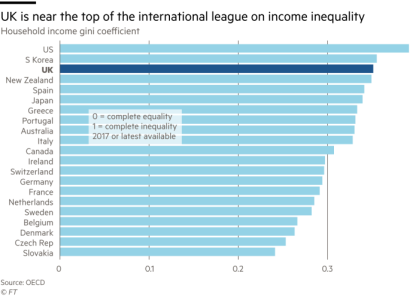
Why is the UK so unequal?

by Kitty S Jones

http___com.ft.imagepublish.upp-prod-eu.s3.amazonaws
The US and UK share an ideology of 'free-market' fundamentalism and competitive individualism. More widely called 'neoliberalism' these ideas were introduced, respectively, on both sides of the Atlantic by Ronald Reagan and Margaret Thatcher. 
Earlier this year, Angus Deaton, professor of economics at Princeton University and a Nobel laureate, launched a five-year review on the subject of inequality. Sir Angus, who is teaming up with the Institute for Fiscal Studies, with funding from the Nuffield Foundation, a charity, intends the review to be the “most comprehensive scientific analysis of inequalities yet attempted”, examining not just the gaps between the rich and poor, but also differences in health outcomes, political power and economic opportunities in British society and across the world. 

Personally, I have some major issues with the neoliberal language of "incentives." .....
 More at from Kitty S Jones at https://politicsandinsights.org/2019/08/23/why-is-the-uk-so-unequal/


Equality/inequalities, and the Social Model of Disability

Writing in July 1984 piece entitled 'Equality is Doing What Comes Naturally', Huw Richards wrote:
The American constitution proclaims the equality of all men to be self-evident. However it took until the Civil War to decide that ‘all men’ includes black men. And the battle continues today to extend constitutional equality to women - with the Equal Rights Amendment tantalisingly short of getting enough support to become law. Indeed White House opposition is one of the major forces against the Equal Rights Amendment. The election of Reagan was a major defeat for supporters of equality; for the first time since well before the Second World War a US administration came to office openly rejecting equality as an objective.

It’s a shift paralleled in Britain. Twenty years ago Prime Minister Harold Wilson was saying: ‘All children have the right to a start in life, but not a flying start’. Today the job is held by Margaret Thatcher who believes: ‘Opportunity means nothing unless it includes the right to be unequal’. 
Thatcher — unlike Boris Johnson — had risen to Tory Party leadership while that party was out of office. Later, "the Conservative Party ... no longer certain that the pursuit of inequality won votes ... brought Margaret Thatcher's career to a reluctant end" after the poll tax had proven deeply unpopular. (Yet the 'poll tax' that proved so unpopular was replaced by Council Tax that still taxes tenants rather than land owners!)

Before Thatcher became Prime Minister, Harvey Andrews and Graham Cooper had drawn attention via a song called 'Targets', to the gulf between spin and reality that was propelling 'Mrs T' onward and upward:

"Call us 'equal'? Call us 'proud'?
Call yourself a liar;
No matter what the people do,
They set the targets higher."
I should note regarding the song's
"Someone's got to lead the blind
And see that the cripple rises"
terminology that that song was also written before the Social Model of Disability could draw attention to the true barriers to disabled people's equality and inform the language around disability.)

Andrews later quipped in solo concert that took place in London before the Conservative Party ousted Margaret Thatcher as their leader, "I tried to warn people about her, but Jimmy Young would not play the record."

'Incentives', participation and disability

The Social Model of Disability draws attention the the physical, social and economic barriers that obstruct disabled people's participation in society, as does this recent Disability News Service account regarding the situation of a disabled person who might otherwise be portrayed as "a burden on society":

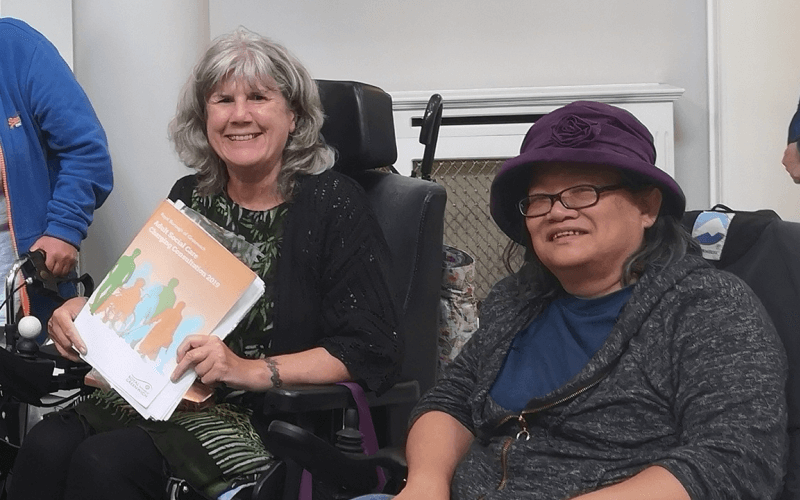
Two women, both wheelchair-users, one of them holding a document
Anne Novis (pictured, left, holding a consultation document on the proposals), who chairs Inclusion London, and received a commendation from the Metropolitan police only last month for her work as an independent advisor to the force, said she was likely to have to quit both those voluntary positions if the council’s proposals went ahead.
Because she was left some money when her mother died, Novis will be hit hard by the reduction on the cap in charges. She is set to lose support worth £3,500 a month.
She said: “If that is removed as proposed, I will have to pay for all my care, an impossible request if I am to live.” [Continue reading at https://www.disabilitynewsservice.com/councils-planned-care-charge-rises-could-prove-fatal/]
Financial incentives clearly fit into a capitalist system and its ideology. Anne Novis, like many disabled volunteers regardless of our politics, volunteer as a means of participation in society: "No-one is an island entire and of itself." In my personal experience as a disabled volunteer and jobseeker, I found that cuts in public spending and shifts in government priorities were a major determinant of the outcomes for my career advancement.

As an example, I was praised for my "endless patience with slower learners." I was a Basic Skills Learning Support volunteer in 2004 in a non-statutory funded Computer Club for adults with learning difficulties, and a slower learner myself. As a child I had struggled to achieve basic literacy, to the point of being hit by child rheumatism before I was given extra tuition at school and home access to Encyclopaedia Britannica in a middle class family. So, mine had not been the kind of "flying start" that Harold Wilson had objected to in 1964, but helped lead me to literacy behaviours and skills.

By the same token, the purchase for me of a home PC in 1998 after my experience of Training & Enterprise Council-funded access to computer skills training had proven inadequate with my much slower learning pace and no home access to a Windows PC, gave me a relatively 'flying start' to Windows Computing that I passed onto other disadvantaged learners from 2004 to around 2010 as a one-to-one teacher of such skills to other disadvantaged learners.

Yet the Learning & Skills Council London Central that "[existed] to help make England better skilled an more competitive" was ignorant of the learners to instructors dynamics of supporting pre-literate adults and prioritised promoting National Vocational Qualification Levels 2 and 3 outcomes toward implementing London 2012 Olympics, at the expense of NVQ Level 1 take up, and so that Computer Club ran out of non-statutory funding and cuts in statutory funding for paid staff.

(Learning & Skills Councils had replaced Training & Enterprise Councils.)

That and further cuts denied me opportunities to advance, and in 2018 I retired after having been a claimant of Employment & Support Allowance since 2009.

The financial incentives argument in a world of diminishing resources gives rise to increasing narcissism


Before I close this article or its drafting for now, I shall give brief mention to forest fires in the Amazon, the 'war of words' between world leaders arising from that, and how consumer action might be an antidote to the narcissism that seems to be worshiped in a commercial advertising sponsored media society.

Thinking of including an image of Amazonian forest fires, I just keyed into the advertiser-sponsored Google search engine the keywords
amazon forest fires
and the search engine suggested
amazon fire stick
a technology pioneered by one of the world's wealthiest men, Jeff Bezos, founder of Internet based company 'Amazon'. That incident in itself heps to highlight the interplays between the framings of 'opportunity' and capital. Before I entered uni in 1993, Windows(R) personal computing was not as mainstay as it had become when I entered training for NVQ accredited Microsoft Office skills training in 1997. Now, Microsoft co-founder Bill Gates is one of those popularising a view that the world has never been better, and getting heard.

Gates is clearly not a claimant of the UK's 'digital by default' run Universal Credit. But to return to the matter of forest fires raging in the Amazon, the lungs of the world.
Amazon forest fires LIVE update
A 'war of words' has erupted. In such circumstances, ultimately, perhaps a closer look at the root causes of Amazon deforestation, followed by consumer action, is the most powerful thing we as consumers can do?

As has been reported, a major source of the Brazilian urge for deforestation is palm oil cultivation Few people read the small print regarding ingredients of palm oil products such as those produced by Procter & Gamble. Similarly, an ingredient in many supermarket bought biscuit packets is also palm oil, as I've noticed only through reading the small print ingredients lists on the packets. We live in a global market in which the source of origin of, say, beef products is obscured, as I reported recently. We should examine the link between the global cattle feed industry and Amazon deforestation. And take consumer action!

I close with a link to an article regarding matters of rising inequalities, and how the 'entrepreneur' role in neoliberal capitalism ties in with narcissism.

Unhappy talk: Spirit Level authors are back

Anyone, Mrs Thatcher believed, who rides a bus or a tube after the age of 30 is a failure. She envisaged a car-owning democracy and herself was carried about like a four-wheeled Queen of Sheba. Clement Attlee, the PM who brought in the post-war welfare state, was often seen going to work on the Underground from Stanmore to Downing Street. Don’t expect to see Theresa May sitting next to you on the Northern line.

He says many foolish things, but among the most foolish is the view, expressed by Boris Johnson, that society is like a packet of cornflakes (echoes of Forrest Gump’s box of chocolates): shake it and the genetically gifted cornflakes will rise to the top. Like Boris.
Wilkinson and Pickett (with the usual supporting barrage of graphs) see it differently. “The belief that people are genetically endowed with substantial differences in intelligence and ability, which determine where they end up in the social hierarchy, is almost the opposite of the truth,” they tell us.


We’ve never had it so good but Heaven knows we’re miserable now. A follow-up from the authors of The Spirit Level asserts that inequality is to blame, says John Sutherland
02 August, 2018 — By John Sutherland
Those who reach the peaks in an entrepren­eurial society, like those of the US and UK, they assert are quite likely what they call “snakes in suits”. Entrepreneurism has created “an epidemic of narcissists”. What do narcissists lack? Empathy.

Narcissists, like snakes, are out for themselves. Try stroking one.

Oddly, Wilkinson and Pickett don’t mention the sociologist who pioneered the techniques they use. Why, asked Emile Durkheim (definitely a top cornflake), are Catholics less prone to suicide than Protestants?

A moment’s thought supplies answers – look, for example, at the families coming out of Our Lady of Hal church, in Arlington Road, on a Sunday.

The biggest causal factor in suicide was what Durkheim called anomie. Rootlessness.
Why is there an epidemic of self-harm, gloom and suicide among today’s young – even that privileged elite at university? “Deracination”, loss of community. We live in lonely crowds.
“Human beings are more fundamentally social animals than is often recognised” assert Wilkinson and Pickett.....
[Continue reading at http://camdennewjournal.com/article/unhappy-talk-spirit-level-authors-are-back if you so desire.]


In conclusion to this blog posting, I believe that in the 'global village', we are all connected and the fate of the world depends on our taking that reality on board and acting upon it.


Friday, 23 August 2019

Disability News Service updates, Thursday 22 August 2019

Wednesday, 14 August 2019

Disability News Service output Thursday, 8 August 2019

Disability News Service (DNS) aptly describes itself as "the [UK's] only news agency specialising in disability issues." It is run by John Pring, "a disabled journalist who has been reporting on disability issues for nearly 25 years," and updated by every Thursday evening.


Top Story


Latest Stories


Tourist attraction could face legal action after ‘years of access failings’


A world-renowned London tourist attraction could soon be facing legal action after failing for years to address its glaring access flaws, according to a former adviser. Disabled broadcaster, journalist and access consultant Mik Scarlet said it was “shocking” that a top London […]

New figures raise fresh questions over Atos PIP assessments


The amount of time that nurses and physiotherapists spend carrying out face-to-face disability benefit assessments can vary hugely, depending on where the test takes place, according to analysis of new Department for Work and Pensions (DWP) figures. Although the figures do not […]

Disability Labour crowdfunds costs for conference access hub after party ‘snub’


Disabled delegates who are providing free access and mental health advice and support to delegates at next month’s Labour conference have had to launch an “embarrassing” crowdfunding appeal after they say the party refused to pay for any free accommodation. At last […]