Search This Blog

Wednesday, 4 September 2019

High Road West, Tottenham housing project "an inhuman treatment of powerless tenants" — Taxpayers Against Poverty

2. An inhuman treatment of powerless tenants. 

TAP is opposing in the implementation of the project at High Road West. We so firmly believe it is against the best interests of the low income residents of Tottenham. After the secure tenants were moved out, the current tenants of Love Lane Estate have been moved in by Haringey Council. Because they are homeless families in temporary accommodation they have no relevant housing rights and can be moved out more easily before demolition. An inhuman treatment of powerless tenants.

Some of these 180 young families have been in temporary accommodation for up and over ten years. They have already been forced to moved several times so disrupting the education of their growing children. They are among 3000 homeless families in temporary accommodation in Haringey. Too many of them are in one room in hostels or other accommodation -  when none ought to be.

The way the High Road West project has been designed does not commit the council to using 100% of the site for meeting part of a target of providing the 3000 much needed secure homes for the homeless.  What is proposed is the convoluted process of allowing Lend Lease to build on land which is free to the council and then sell "affordable" homes back to the council for £68,000 each. That enables Lend Lease to make the largest profit possible by selling the remaining and the majority if the homes into the very expensive London housing market.

The best way to build truly affordable homes for rent is for the council keep their public land out of the market, borrow the money and hire Lend Lease to build them.

It is a matter of public interest that we all know the terms of the  out of court settlement bewteen lendlease and the council, particularly whether it involved Northumberland Park, another council estate eyed by international property devopers for similar treatment.

Another shocking aspect of the High Road West project is the intention to grab the land from under 50 small thriving businesses of the Peacock Industrial Estate. Their businesses, which are employing local people, will be severely disrupted - to create a park!
 

The current national housing policy is ideologically designed to prevent the building of council homes on council land.

To do so is not socialism. It is simply an intelligent way of building truly affordable housing which has been used by all political parties in power since WWII. Also the capacity of the poorest tenants to pay even the lowest rents in London has been severely undermined by the shredding of housing benefit and other social security payments. (See above)

Now is not the time to build social housing at council house rents. It would be better to leave it until after the next election which will have to change national housing and social security policies for the better and , it is ardently hoped. for the better use of public and private land for the common good.

For the time being the council ought to stop pushing powerless homeless families in temporary accommodation from pillar to post. The council can leave them where they are - even declare them all permanently housed.

National housing and social security policies have to change  to meet the needs of low income tenants.

Taxpayers Against Poverty

A VOICE FOR THE COMPASSIONATE MAJORITY

No citizen without an affordable home and an
adequate income in work or unemployment.

TAP DEPENDS ON SUPPORTERS - PLEASE CONSIDER

MONTHLY CONTRIBUTION - THANKS


Twitter
Facebook
Website

Copyright © 2019 Taxpayers Against Poverty, All rights reserved.


I, Alan Wheatley, in forwarding the above from Revd Paul Nicolson of Taxpayers Against Poverty, refer the reader of this to
  1. Taxpayers Against Poverty site search 'Lend Lease'
  2. Taxpayers Against Poverty site search 'Tottenham Hotspur' helps outline the fact that that Premier League soccer club at least is more of a franchise for 'global brand' than a local outlet for 'the people's game'

"General Election manifestos must address homelessness and hunger" — Taxpayers Against Poverty

1. GENERAL ELECTION MANIFESTOS MUST ADDRESS HOMELESSNESS AND HUNGER. 

The 2012 and 2016 Welfare Reform Acts were seen through Parliament by government ministers who sought to force the unemployed into work by imposing inadequate incomes and punitive laws designed to treat them as if they are at work.
Examples are:
  • a monthly rather than a weekly income;
  • housing benefit paid to the unemployed from which they pay the rent to the landlord as if it were from a monthly pay cheque; and
  • strict rules about keeping appointments at the job centre.
The purpose was to “change the culture” of unemployment, on the mistaken assumption that the unemployed lived an easy life on benefits so were unlikely to look for work, hence the cruel benefit sanction on those who “broke the rules”.
Lord Freud  on the Welfare Reform Bill 2016. Hansard Column 1427, 19 October 2016:
Every year I stand here because there is a forecast that says that child poverty is going up, has gone up or will go up, but when we actually see the figures, we find that child poverty has actually gone down. When you transform the economy, change the culture so that work is what has been driving things, and move up the employment rates and the earning rates in the way that we have, you find that the behavioural impacts are very different from the static analysis that many of the external experts tell us about.”

Lord Freud could not have been more wrong. Child poverty is going up and getting worse. 
Attempts by cross-bench peers to insert amendments requiring a health-impact assessment of the government’s policies were rejected. The actual and disastrous impact on the health of low-income families and individuals can be found on the Taxpayers Against Poverty website.

UK land grabbed by the rich for private gain
London councils have published analysis showing that there has been a significant reduction of about 200,000 in the number of homes that are affordable for tenants receiving the Local Housing Allowance. That is one among a number causes of the escalating homelessness and hunger in the capital.
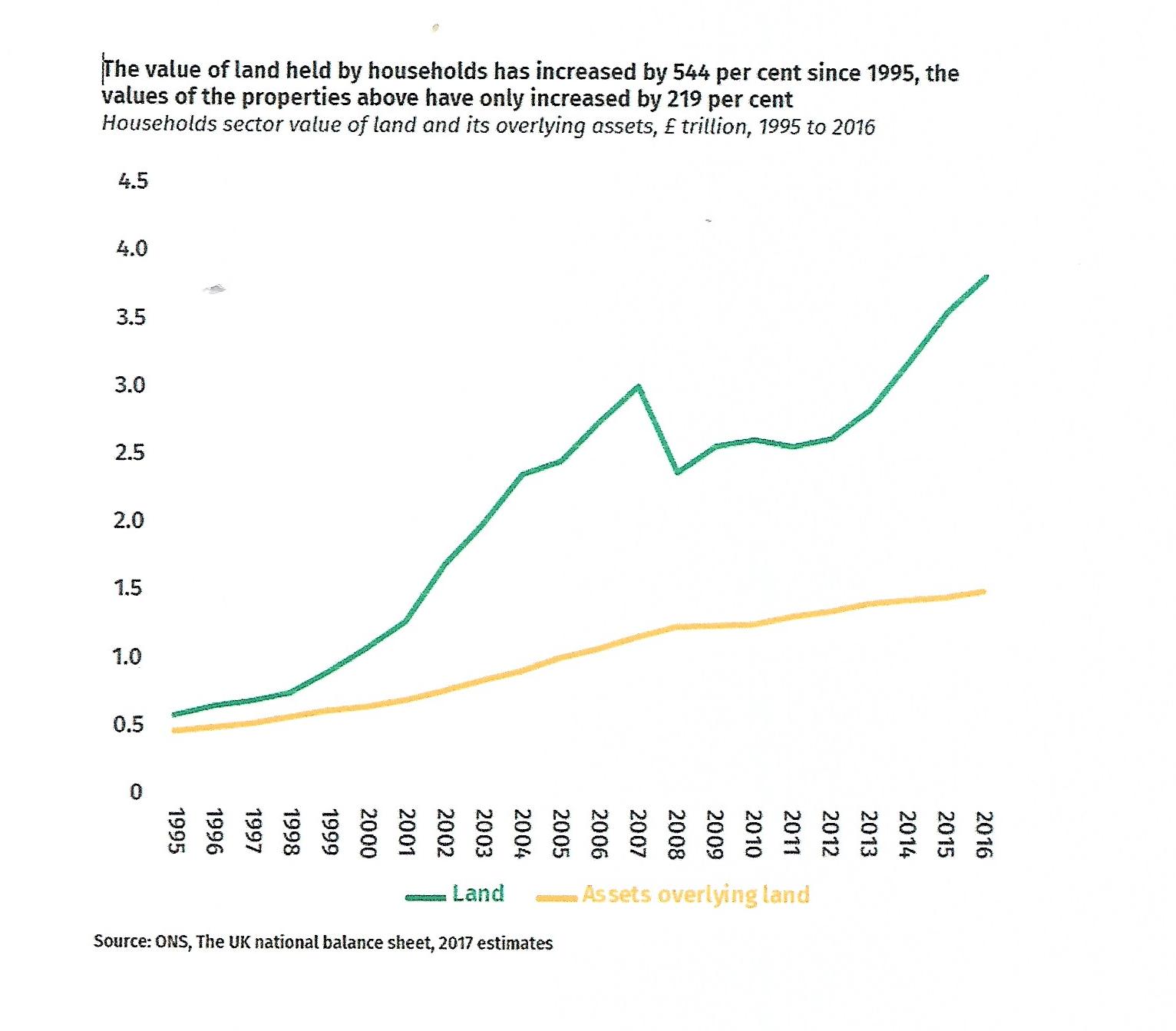
The 1980s’ “big bang” set up the UK housing market to make large landowners very rich indeed, with unearned and untaxed increases in the value of their land. Lending was deregulated, rent controls abolished and funds allowed to flow in and out of the limited amount of British land. Small businesses and family homes, which pay rent, business rates and/or council tax, and own no land, are treated little better than during the 15th- and 16th-century enclosures.

Tenants are being pushed off the land with no solutions on the political table to reverse the trend.
In Haringey, 3,000 homeless families, with 5,208 children between them, have been forced into temporary accommodation, some for up to and over 10 years. Accirding to the House of Commons Library there are 83,700 homless families in temporary accommodation in England with 124,000 children, up 74% sine 2010. 56,880 of the families are in London. Too many of them are in one room in hostels or other acommodation when none ought to be

Graph from IPPR (Institute for Public Policy Research)
      

Taxpayers Against Poverty strongly recommends that the Greater London Authority and Parliament adopt two policies used by the Danish government:
  • Long-term vacancy of properties is discouraged in Denmark. If an owner moves and does not wish to sell the property, it must be rented out or advertised for sale. If it is empty for more than six weeks, the owner must report to the local authority, which then seeks to provide tenants, whom the owner has to accept.
  • Non-residents of Denmark who have not lived in the country for a total period of five years previously may only acquire property after receiving permission from the Ministry of Justice.

Income support for a single adult has been losing value since 1979
There is a community of about 11,000 social-security claimants in Haringey. The shredding of their social security incomes since 2010 has been piled on top of decades of adult benefit negligence. The evidence came from Professor Jonathan Bradshaw in 2009  responding to one of mine. In April 2011, austerity measures were then piled onto an already inadequate cornerstone of the benefit system. To that cornerstone are added disabled people’s, children’s, housing and council-tax benefits. 
“When unemployment benefit started in 1912, it was 7 shillings a week – about 22% of average male earnings in manufacturing. The percentage fluctuated over the succeeding decades, but by 1979, the benefit rate was still about 21% of average earnings (manual and non-manual, male and female). By 2008, however, as a result of the policy of tying benefits to the price index while real earnings increased, the renamed Jobseeker’s Allowance had fallen to an all-time low of 10.5% of average earnings.”
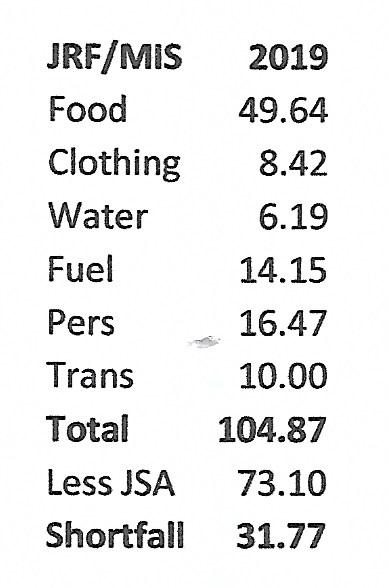
Benefit increases were frozen at 1% a year in April 2011. £73.10 a week Jobseekers’ Allowance equates to £317 a month Universal Credit. Using the Joseph Rowntree Foundation’s minimum-income standards for single-adult benefits after rent and council tax as of April 2019, we can see that Jobseekers’ Allowance and Universal Credit are nearly £32 a week too low for healthy living.
And that is before 
  • the five-week delay in the first payment of Universal Credit; 
  • the Department for Work and Pensions “budgeting advance” to cover that delay, which is a loan that has to be repaid out of 73.10 a week; 
  • the cuts in council tax and housing benefits, which mean rent and council tax must also be paid out of that £73.10 a week; 
  • income is stopped by benefit sanctions, during which rent, council tax and TV-licence arrears and other debts pile up; adding to the impossibility of living on benefits; 
  • the realisation – often only belatedly at the job centre – by a parent who has a third child that the government’s two-child policy means they will be refused child benefit for their latest offspring. 
The hopelessly inadequate single adult benefit cannot maintain a healthy adult life, let alone pay rent or council tax, or their enforcement costs. That is a cruel catch 22. If your children’s benefits pay the rent, they are hungry, naked or cold; if you feed, clothe growing children or keep them warm, then the family is evicted and homeless.

Low-income tenants forced into the benefit cap
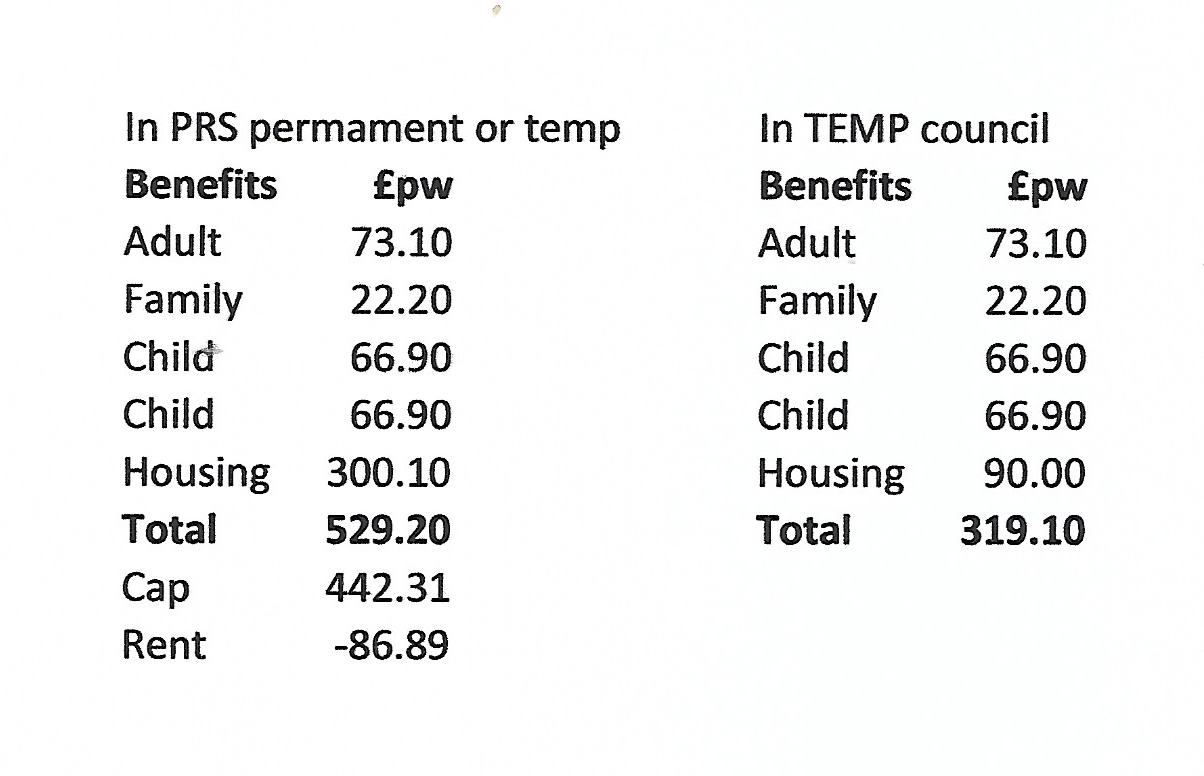
In the United Kingdom, local authority officers and benefit claimants are both the victims of toxic and disconnected central government policies that combine to escalate the number of homeless and hungry families. The benefits freeze is bad enough (Benefits freeze leaves a third of claimants ‘with £100 to live on a month’), but, in 2012, the government introduced another measure that is particularly hard on London families. It allows local-authority housing departments to offer homeless families in temporary council housing at £90 a week rent a move into permanent private-sector housing at £300 a week rent for a two-bed home, for example (see table).
Families must accept the council’s first offer or they are deemed intentionally homeless and struck off the list of those the council has a duty to house. The unintended consequence of the 2012 measure is that a family’s total benefit income, including housing benefit, can be forced over the London benefit cap of £442.31 by high private-sector rent. The government cuts the housing benefit to enforce the cap on the total benefit income, leaving that rent to be paid by the family’s remaining benefits, which have been frozen and are already short of £100 a month to live on. Hunger and homelessness are inevitable.

UK is the only nation in the world requiring renters to pay the landlord’s property tax.
The UK being the only nation in the world requiring renters to pay the landlord’s property tax adds the straw that breaks the camels back. That is a great injustice. The council tax is a property tax based on 1991 evaluations after the poll tax was abolished and the council tax introduced.
There is a tenant of my acquaintance who lives in a private two-bed terraced house in Tottenham that was bought new for £95,000 in 1999. An identical property next door, also new in 1999, is on the market for £425,000. The landlord is £330,000 richer, unearned and untaxed, while the tenant has paid about £1,000 a year in property/council tax for 20 years, so is £20,000 poorer.
290 out of 326 English councils require benefit claimants to pay a proportion of their landlord’s council tax. It is enforced by the magistrate’s court, adding the council’s enforcement costs to the arrears and the bailiffs adding their fees. Taxing £73.10 a week income support/Jobseekers’ Allowance/Universal Credit is a pernicious injustice.
The good health and wellbeing of all UK citizens in or out of work must now become a national priority. 

Taxpayers Against Poverty

A VOICE FOR THE COMPASSIONATE MAJORITY

No citizen without an affordable home and an
adequate income in work or unemployment.

TAP DEPENDS ON SUPPORTERS - PLEASE CONSIDER

MONTHLY CONTRIBUTION - THANKS


Twitter
Facebook
Website
Copyright © 2019 Taxpayers Against Poverty, All rights reserved.

Friday, 30 August 2019

LB Camden to hold its own rally vs UK Parliament shut down

Originally published at Camden New Journal

Camden to hold its own rally against parliament shutdown


Demo to be staged in Russell Square on Saturday
29 August, 2019 — By Richard Osley


A RALLY against Boris Johnson’s decision to shut down parliament – a move widely seen as a measure to make it harder for MPs to oppose a no deal Brexit – is to be held in Camden this weekend.

Labour council leader Georgia Gould said this evening (Thursday) that opponents to a crashing divorce from Europe and the Prime Minister’s prorogation tactics were uniting for the event in set up for  Russell Square.

Cross-party speakers will take over the park on Saturday for the ‘Camden Defends Democracy Rally’ from 10,30 am with organisers urging residents to show the strength of feeling by joining them there.
Cllr Gould will be joined by Hampstead and Kilburn MP Tulip Siddiq, Holborn and St Pancras MP Sir Keir Starmer, Camden Unison branch secretary Liz Wheatley, Sian Berry, a councillor in Camden and also the Green Party’s national co-leader, and representatives from the Liberal Democrats.


After the rally, campaigners will head to a national protest outside Downing Street.

SEE ALSO ‘OUTRAGE’ AS BORIS JOHNSON SHUTS DOWN PARLIAMENT IN BREXIT BATTLE

“Camden will not stand by and watch an unelected Prime Minister trample on our democracy to force through a ‘no deal’ Brexit,” said Cllr Gould. “Camden is proud of our diverse community, our connections to Europe, our EU citizens, our openness and we stand in solidarity with our allies across the UK and EU making their voices heard..”

Around three quarters of Camden residents who took part in the 2016 EU referendum voted to remain in the union.


Priorities re organic fruit and veg buying to avoid pesticide use

Via a 'What Doctors Don't Know' magazine online article, 'The truth about pesticides' with keywords or 'labels'
  • Blood
  • Fertility
  • Infertility
I've just been introduced to an 'Environmental Working Group' (USA) online video,  that I commend my readers who are interested/concerned about such matters check out. It's called 'EWG and Pesticides: The Dirty Dozen'. In view of concerns about 'food miles', however,

I would also advise my readers to consider the prospective impact of buying organic fruit and vegetables.

I publish this precis with the caveat that the 47 types of fruit and vegetables tested for pesticide scores were from the  American field rather than those produced in the European Union that has different standards.

Further to this, 'EWG and Pesticides: The Dirty Dozen' recommends that if you can't afford to buy organic, you attempt to wash off pesticide residues from
  1. Peach
  2. Apple
  3. Bell Pepper
  4. Celery
  5. Nectarine
  6. Strawberries
  7. Cherries
  8. Kale
  9. Lettuce
  10. Grapes (imported)
  11. Carrot
  12. Pear
preferably with the aid of bicarbonate of soda.

"On the flip side," the online video advises that Onions, Avocados and Broccoli are three vegetables with the least amount of pesticide residue in this American-based sampling.


Alan Wheatley


Debt slavery of a nation disastrous for planet Earth

I preface this intro to a New Internationalist magazine online article by stating that I am in favour of the UK remaining in the European Union. The EU is not perfect in my view, and should be reformed from within. And as a member state of the EU as well as being one of the G8 economies of the world, the UK potentially can help transform the EU as an agent to reverse Climate Catastrophe tipping point.

I note though that the EU's European Central Bank — together with the International Monetary Fund and World Bank — has operated like an economic and environmental criminal regarding the formulation of land usage for former Soviet Bloc nations Poland and the Czech Republic, toward orienting those nations' economies toward fossil fuel extraction and large scale farming for export.

Naomi Klein has written of how the Troica [IMF, World Bank and European Central Bank] perverted the prospects for the Polish economy by way of "debt slavery" of a nation. The events also form the backdrop to Andrzej Stasiuk's novel 'Nine'. See The Portrayal of Despair in Poland after 1989: Stasiuk's 'Nine' and Melanie Klein's 'The Shock Doctrine'.

For more on the EU's Common Agricultural Policy's impact on Poland, for example, see Compassion In World Farming's review of Julian Day Rose's 2013 book In Defence of Life. More recently, the 'Conference of Parties' [to an international agreement aimed at limiting global emissions of greenhouse gases] COP24 was hosted in Poland. You can read up at New Internationalist website of how the purpose of those talks was perverted by commercial sponsorship.
https://newint.org/search?key=cop24+poland+fossil+fuels&sort_by=search_api_relevance

More recently the impact of the European Central Bank on the Greek economy has become infamous in terms of the hardships of the Greek people, yet the environmental impact of such debt slavery is only just emerging, as Zoe Holman outlines at New Internationalist:

Greece opens its arms — and seas — to hydrocarbon giants


The Syriza Party leader was first elected on a promise to scrap the draconian terms for a bailout set by the European Union and the IMF. He later went back on his pledge, accepting the EU's mandated austerity measures.
One afternoon in early July, Jenny Pyliou looked out onto her land, part of a protected nature reserve in Thesprotia, northeastern Greece, to see a group of researchers for the Spanish energy company Repsol sticking rods with explosive devices into one of her fields. Her husband called the police,  who on arrival, instructed the workers to remove the instruments, noting that oil exploration activities had not be approved in the area.

The following day, the men returned to reinstall the devices, informing the Pylious that they were extremely costly and that the couple would be liable for any damage if they removed them. Such antics by the oil companies, who get up to them with relative impunity, are what Greeks can now expect more of following the government’s licensing in late June of major hydrocarbon exploration by oil giants ExxonMobil and Total.

‘Now that Pandora’s box has been opened, this issue is going to stay with us – one way or another, Greece will be labelled as an oil country,’ says Giorgos Velegrakis, a post-doctoral researcher on the history of oil in Greece at the University of Athens and a member of the nationwide Initiative Against Hydrocarbon Exploration. ‘This was out of the question a decade ago, but now you never know what will happen.’ ....

Former Finance Minister of Greece, Yanis Varoufakis, has written illuminatingly regarding the debt trap, and I commend:
Meanwhile, I believe that the current state of Greece surrendering its national sovereignty to major agents of Climate Catastrophe may give an indication of what might be included in Boris Johnson's ' 'bold new agenda' for the UK Parliament.

The HydroCarbon Industry is truly a nasty face of global industry despite all its greenwash

The purveyors of non-renewable energy from hydro-carbons seek to profit from the colder winters that global warming is bringing on: they have as much compassion for their customers as heroin and cocaine pushers have for theirs. There might not currently be laws against what they do, but ....

Much better for the UK and the globe are Fuel Poverty Action and its agenda.

I close with a youtube reference to an American tale of how mining destroyed a family home and its surrounds in western Kentucky. It's a Jean Ritchie song that I've treasured for over 40 years, and a much lighter song that she recorded with Oscar Brand, 'A Paper of Pins'.


Alan Wheatley

Alison Mann helps Herefordians empower themselves with Yogic Breathing


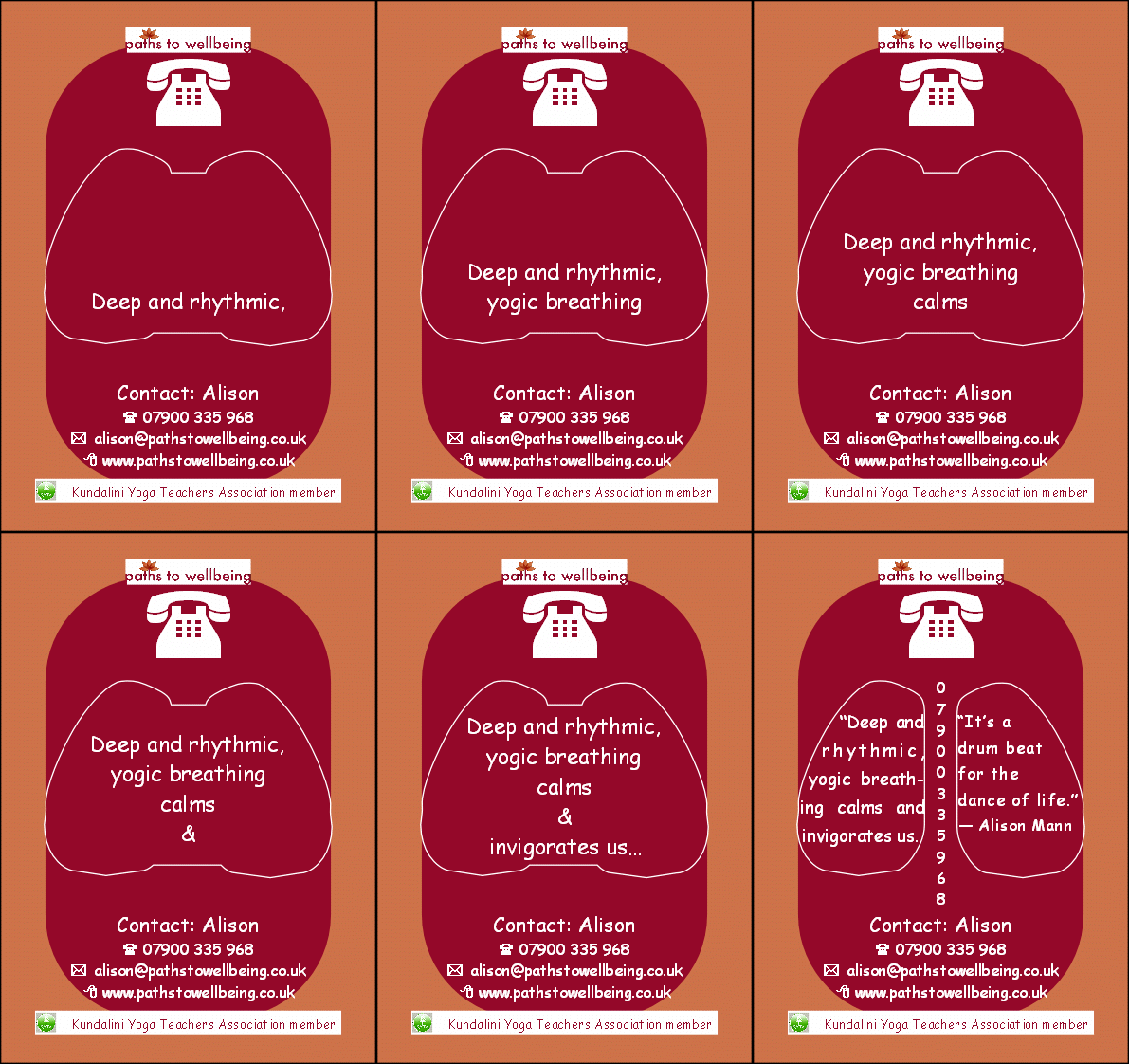
Alison Mann: Deep and rhythmic yogic
breathing calms and invigorates us.
It's a drum beat for the dance of life.

Alison Mann helps to deliver Yoga and Ayurvedic Massage throughout Herefordshire


(This post was originally published Thursday 8 August 2019. My republishing it now serves as a counterpoint to our state of having someone I did not vote for imposing his style of 'Nanny State' on the electorate. Yogic Breathing is empowering)


I've just returned home from a 7am to 8am Kundalini Yoga class at Clear Space Studios, Hereford, HR4 9BX with Alison Mann of Paths to Wellbeing.

Among other things, these classes are a great aperitif or physical and mental warm-up for my one-to-one Ukulele and singing class later today at Music Plus, 30 Union Street, Hereford HR1 2BT. Like Alison, my teacher at Music Plus Ltd is great, very inspiring, and emphasises the importance of breathing deeply and rhythmically.

In celebration of both, I take the opportunity to share here an animated text image I've been working on with and for Alison. (To get this animation to replay, press the 'refresh' button of your Internet browser program.)

Yoga is one form of Ayurvedic ('Life Knowledge') Medicine; Alison also delivers Ayurvedic Massage.

Music Plus Ltd, 30 Union Street, Hereford. offers lessons in guitar, ukulele and singing with clarity that helps musicians develop

(Originally published 11 August 2019)

Music Plus Ltd, HR1 2BT. offers lessons in guitar, ukulele and singing

"Imagining your foot as a metronome is a first step on the road
to musicianship." — Music Plus Ltd, Hereford delivers lessons
in guitar, ukulele, banjo, bass, and mandolin

"It is imperative that you relax into feeling the beat with your foot," says my teacher at Music Plus Ltd, Hereford


Last Thursday, I delighted in another Ukulele and Singing lesson at Music Plus Ltd, Hereford. The above animated tapping foot image was based on more than one of the musicianship learning principles he has helped reinforce and imbue in me in each 30 minute contact session and follow-through homework.

First principles

"Music is noise organised by rhythm and pitch.
Rhythm is the more important."

My first Ukulele lesson at Music Plus Ltd was in May 2019, two years after leaving London where I had been studying acoustic and Classical Guitar since 2011 in 30 minute one-to-one lessons on weekday evenings about an hour's journey from my then home, with Ray Gallo in London, N8; the music helped me relax, but the getting there with guitar on packed public transport was a more stressful journey, while the lessons helped prepare me for greater things.

A really great thing about the Music Plus-based set up in Hereford is the waiting area, allowing me to arrive early on a weekday afternoon, arriving much more relaxed. Like Ray Gallo in London, N8, my teacher at Music Plus Ltd helps ensure that I receive water if I need it, adding to the build up of relaxation that he believes in as essential to learning processes and applied musicianship.

Before booking my first lesson at Music Plus Ltd ("The MP you can trust"), I got to speak with him at Music Plus face-to-face, ensuring that I could feel comfortable with him. I told him of my early to mid 1980s legacy of studying Associated Board of the Royal Schools of Music (ABRSM, classical) Music Theory up to Grade Seven and my cognitive learning difficulty by which I have difficulties with the more practical side of music. He was very favourably impressed with my theory background as an achievement and keen to work with me in developing my musicianship.

He also mentioned that his training method accords with how LA [as Los Angeles, California, not 'Local Authority'] studio musicians are trained, and he prefers plucking the Uke with a flatpick aka plectrum over finger style.

I can't remember what I performed at my first lesson with him, but recall that in the nervousness of the first encounter situation my nervousness led to a few fumbling mistakes, based largely on the nerve-related pitfall of playing too fast. Yet he recognised that for what it was, and gave relevant self-disclosure account of how he had been nervous in his Bachelor of Music accreditation, playing in front of Elton John's drummer as assessor. I left that session much more relaxed to the point of elation. I walked through High Town, Hereford feeling like bursting into song.

In my first few lessons with my teacher, he commended my foot tapping and my intoning the notes I was picking as basic musicianship behaviours, yet observed that I was the first student to sing the notes of a stringed instrument scales exercise without receiving that instruction from him.

He also emphasises relaxation via building up from slower tempo (hence the very slow setting of the tapping foot tempo above), and the power of imaging and imagination in musical practice. "A guitar student of mine loves dancing, and so I encouraged him to think of his fretting fingers dancing over the guitar neck," he told me.

At one of those earliest sessions I had with him, he asked me for my definition of music before coming up with his definition:

Q: What is Music?

A: Organised noise.

Q: What are the two main ways of organising noise?

A: Rhythm and Pitch.
Rhythm is the most important.
Through our subsequent verbal dialogues, we've established that Phrasing is also vitally important in Music, and is related to scheduling of deep and rhythmic breathing and the concept of answering phrases that parallel the ideas of  'Questions and Answers'.

He also emphasises that modern music is more improvisation-oriented than my ABRSM Music Theory past, and also more rhythmically eclectic and syncopated for people to dance to.

The above gives an outline as to how my teacher works with me in his role as teacher. I've also observed in how he works with very young learners who are accompanied with their parents, that he alters his approach according to who he is teaching: allowing for the much younger learners' more limited attention span, he includes jokes and conjuring tricks to help them continue wanting to be there and build up rapport and learners' stamina.

Relaxation and awareness of the role of the snare drum that he has taught me also helps me 'get in the groove'. He has done that with the aid of his iPad and youtube access as a digital library that includes rhythm tracks that can be more helpful than a handheld metronome.

Acknowledgements

In closing this blog post, I shall give a few 'acknowledgements'.

"Don't belittle your accomplishment!" 

In honour of my teacher's response to my recent quick grasping of playing and singing a 'Circle of Fifths' on Ukulele after he had given me a handwritten 'fill in the gaps' sheet as homework the previous week, I give thanks for my courage and persistence plus other allies in getting to that point after previously having been told, "Shut up! You're tone deaf and have no sense of rhythm" before and after I bought my first guitar in September 1972.

He was "amazed!" at the flexibility and accuracy of my 'Circle of Fifths' performance on Ukulele and Voice. I said that I found it "easy" working from the principle that I could adapt what I'd learnt about 'position playing' on the first three strings of the instrument that Ray Gallo had taught me, and the understanding that to play a key a perfect fifth higher on a guitar-family instrument, I can go up seven frets or down five frets. Hence, he advised me to not belittle what I had made in just one week from his 'fill in the gaps' paper-based exercise.

Ray Gallo (left) and Alan (right) rise for the camerain London N8, March 2017
(Click here for more about Ray, especially if you are a potential 'pupil' of his.)


I put what I have learnt from a succession of teachers and disciplines into practice, and remember to breathe deeply and rhythmically and go with my instincts. Yet my acquired ability to sing in pitch has come from the inner teacher with whom I have become more acquainted through time and self-acceptance.

Digital graphics by Alan using Serif(R) Software

The digital graphics above were created with the use of Serif Draw Plus, Serif Page Plus and Serif Photo Plus software on a Microsoft Windows 7 PC. I have used these tools since about the time I first got a Windows PC at the end of the last millennium, and refined my skills on them by creating customised greetings cards for friendly contacts, own website content, and teaching aids. My mother's purchase of my first Windows PC, and my dedicated practice using training manuals, own project design and self-directed learning really helped establish me as a Windows PC user.

Solovair shoes

At the risk of 'infringing copyright' accusations, the shoe image used in the animated 'foot tapping' graphic above was copied from the website of Solovair shoes. I wear British-handcrafted Solovair shoes myself, and this acknowledgement can be regarded as a means of directing potential customers to the Solovair shoes website, rather than 'infringing intellectual property rights'.